The Hidden Risk of Running Servers Without Health Monitoring
A lot of small environments run on confidence.
The app is up. Users are not complaining. The database responds. Backups seem fine. Everything looks stable.
That is exactly why small server problems are easy to miss.
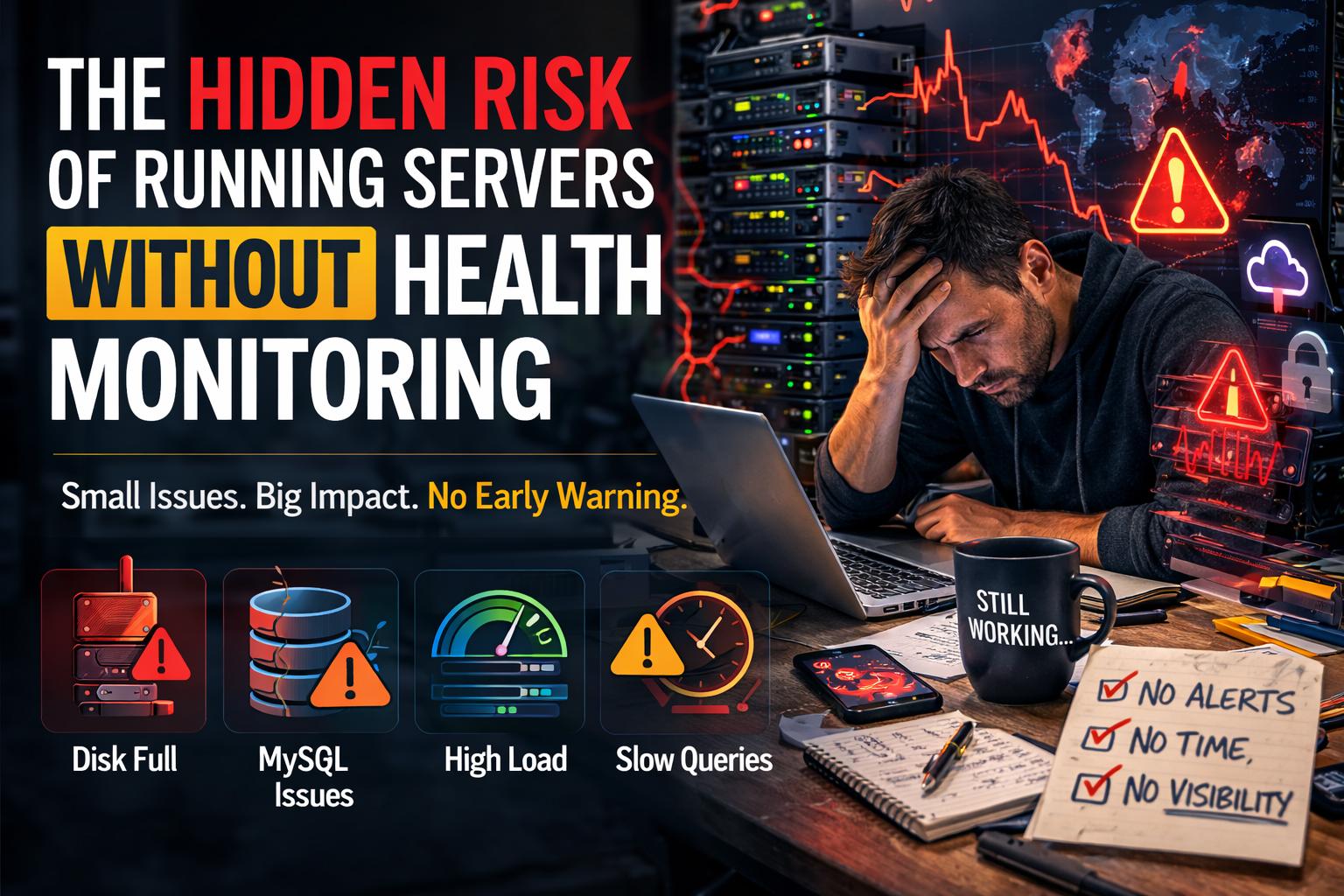
Most outages in small Linux and MySQL environments do not start as dramatic failures. They begin as quiet changes that build over time:
-
disk space slowly filling
-
memory pressure increasing week by week
-
load peaks becoming more frequent
-
MySQL connections rising during busy periods
-
slow queries appearing more often
-
scheduled jobs taking longer than before
By the time someone notices, the problem is no longer small.
The False Sense of Stability
Small production environments often feel simple:
-
one application server
-
one database
-
one small team
-
limited traffic
-
few moving parts
That simplicity creates a dangerous assumption:
If the environment is small, it must be easy to manage without structured monitoring.
In reality, small systems are often more vulnerable because they do not have:
-
a full-time operations engineer
-
dedicated DBA coverage
-
24/7 monitoring staff
-
formal incident review processes
-
spare capacity for surprise failures
When a trend goes unnoticed in a large organization, someone usually catches it.
When it goes unnoticed in a small environment, it can sit quietly until it becomes downtime.
Most Server Problems Start Quietly
Very few infrastructure issues begin with a dramatic crash.
More often, they begin like this:
1. Disk growth is ignored
A log directory grows faster than expected. Backups accumulate. Temporary files are not cleaned up. Disk usage increases little by little until writes fail, jobs stop, or MySQL begins behaving unpredictably.
2. Memory pressure slowly rises
A service uses more memory than it did last month. The server still runs, but swap activity increases and performance becomes less stable under load.
3. MySQL workload changes over time
Threads connected increase. Query patterns shift. A previously harmless report starts running longer. The system is still online, but user experience gets worse and risk grows.
4. Slow queries multiply silently
One slow query is easy to ignore. Ten repeated slow queries every hour are not. Without visibility, the degradation hides behind “the system feels slower lately.”
5. Resource peaks become normal
A CPU spike that happened once a month now happens several times a week. Nothing fails yet, but the direction is clear.
This is the real danger of running servers without health monitoring:
you miss the trend, not just the incident.
Downtime Is Not the Only Cost
When people think about monitoring, they usually think about preventing outages.
That matters, but the cost of poor visibility is broader than downtime alone.
Without structured health monitoring, small teams often deal with:
-
slower applications
-
inconsistent user experience
-
longer troubleshooting cycles
-
emergency weekend fixes
-
uncertainty during deployments
-
difficulty explaining system condition to clients or stakeholders
In a solo-developer or small-business setup, that cost is personal.
It means interrupted evenings, delayed projects, reactive support, and less confidence in the environment.
Why Small Teams Need Health Visibility
A small infrastructure team does not need a giant observability platform to get value.
What small teams really need is early warning through useful operational signals.
That usually means understanding:
-
how CPU, memory, swap, and load are trending
-
whether disk usage is stable or growing dangerously
-
whether MySQL concurrency is increasing
-
whether slow query behavior is changing
-
whether the environment is getting healthier or less stable over time
That kind of visibility supports better decisions:
-
when to clean up disk usage
-
when to tune a query
-
when to review an application change
-
when to add capacity
-
when to investigate unusual behavior before it becomes an outage
Real-Time Alerts Are Not Always the Answer
Many small teams assume the solution is full real-time monitoring with alerts for everything.
That often creates a second problem: noise.
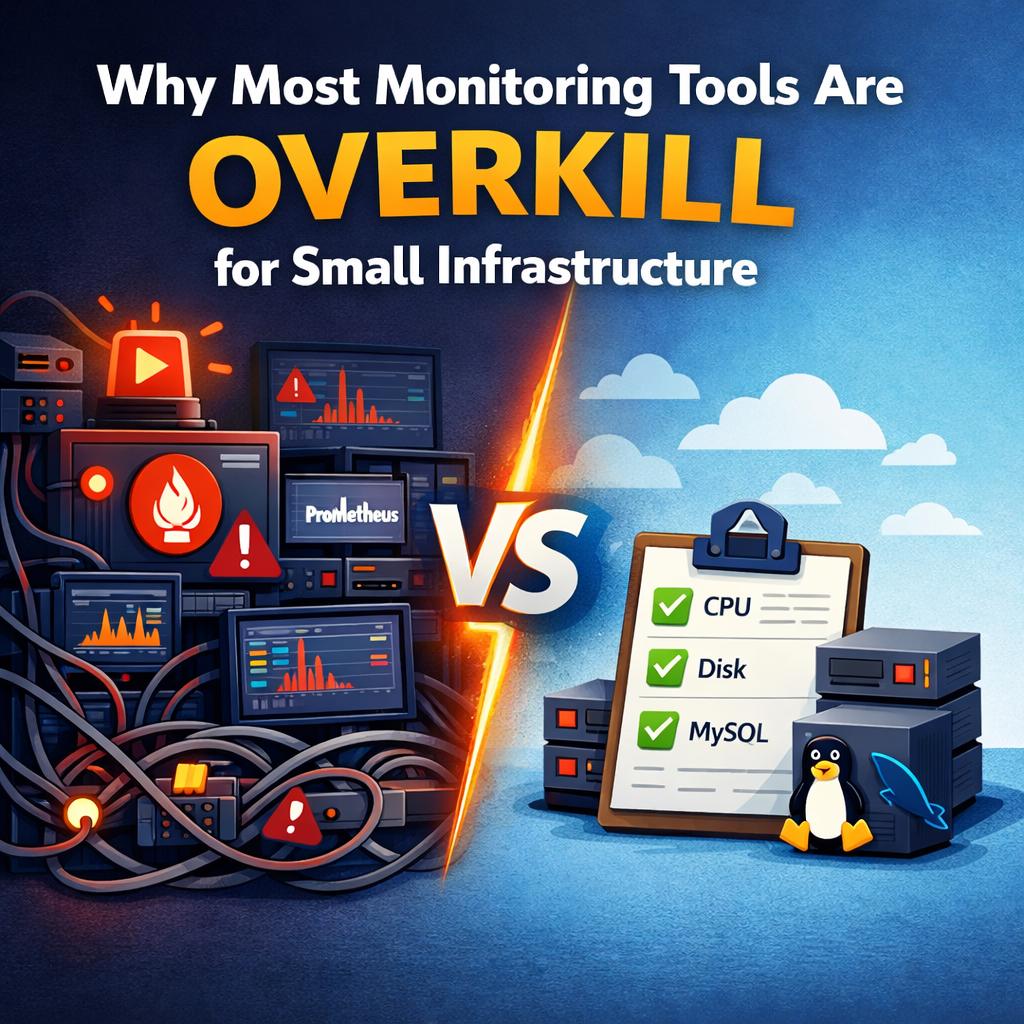
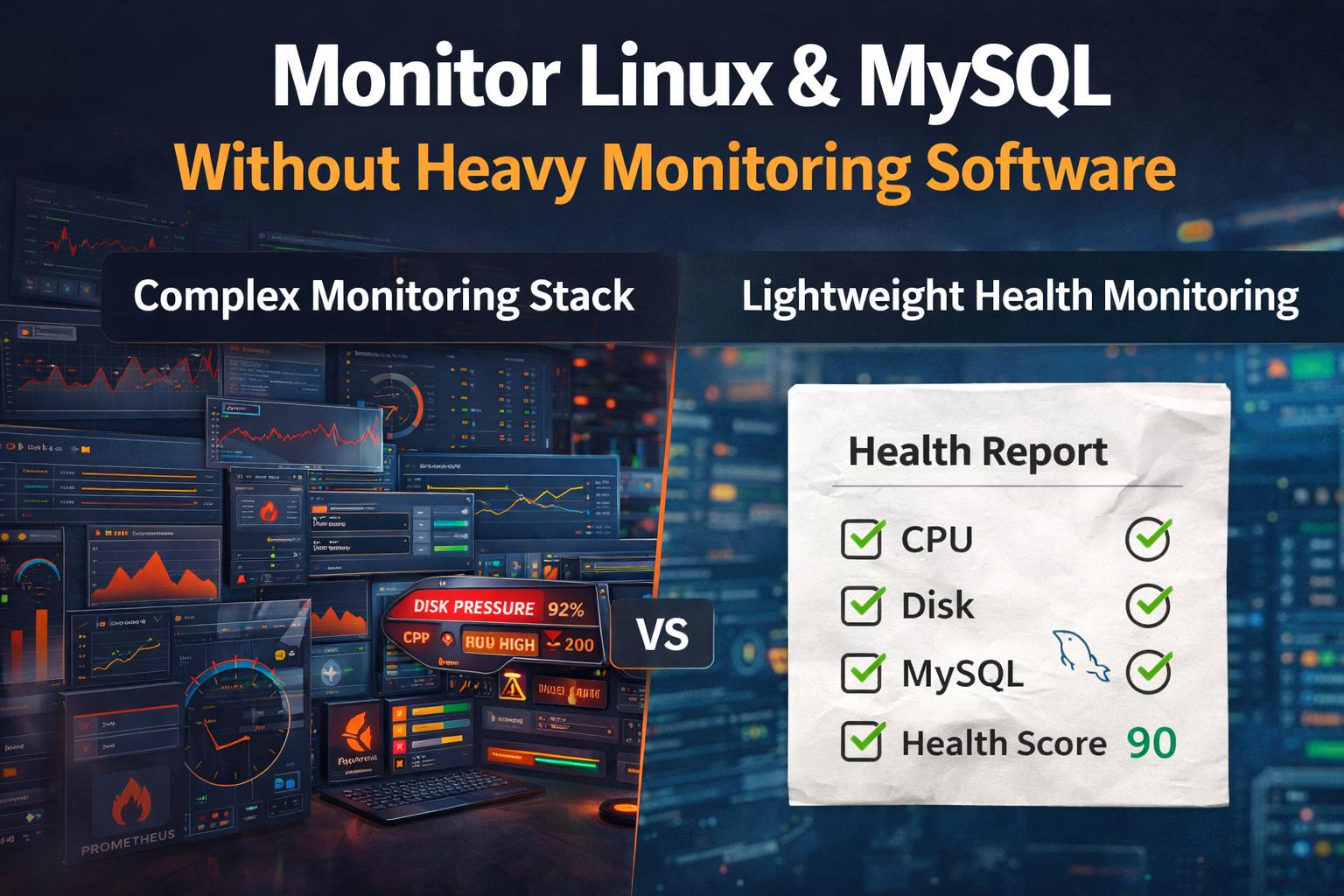
For small environments, alert-heavy platforms can become too complex, too noisy, and too expensive in time and attention. Your own product site already makes this distinction clearly: traditional monitoring creates dashboards and alert storms, while DMCloudArchitect Health focuses on structured reporting and long-term trend visibility.
That is why health monitoring matters.
Health monitoring is not about watching every second.
It is about identifying meaningful changes over time.
For many solo developers and small businesses, that is the better operational model.
What a Healthy Monitoring Approach Looks Like
A practical health monitoring approach for a small Linux and MySQL environment should be:
-
lightweight
-
easy to install
-
low maintenance
-
focused on trends
-
readable by technical and non-technical stakeholders
-
designed to reduce blind spots, not create extra work
It should help answer questions like:
-
What changed this week?
-
Is the server becoming less stable?
-
Are resource peaks getting worse?
-
Is MySQL workload increasing?
-
Are slow queries becoming more common?
-
Is there a hidden issue forming?
These are the questions that help prevent reactive firefighting.
A Better Fit for Small Linux and MySQL Environments
This is exactly where DMCloudArchitect Health fits.
The platform is built around structured infrastructure health reporting for Linux and MySQL, with local collection, hourly aggregated snapshots, and weekly health reports designed to surface meaningful trends without dashboard overload. That aligns well with the needs of solo developers, consultants, and small production environments.
Instead of asking a small operator to build and maintain a heavy monitoring stack, the product focuses on the signals that matter:
-
resource pressure
-
disk growth risks
-
MySQL health trends
-
slow query visibility
-
degradation detection over time
That is the right model for people who need operational awareness without another system to babysit.
Final Thoughts
The biggest risk in running servers without health monitoring is not that something might fail instantly.
It is that the system can drift into failure while appearing “mostly fine.”
Small production environments deserve visibility too.
Not because they are large.
Because they are important.
If your Linux server or MySQL database supports a real business, client workload, or production application, you need a way to see what is changing before it becomes a problem.
CTA
If you want a simpler way to monitor small Linux and MySQL environments without building a heavy monitoring stack, explore:
DMCloudArchitect Health
https://health.dmcloudarchitect.com
Structured weekly health reports. Trend-based infrastructure insight. Less noise, more clarity.